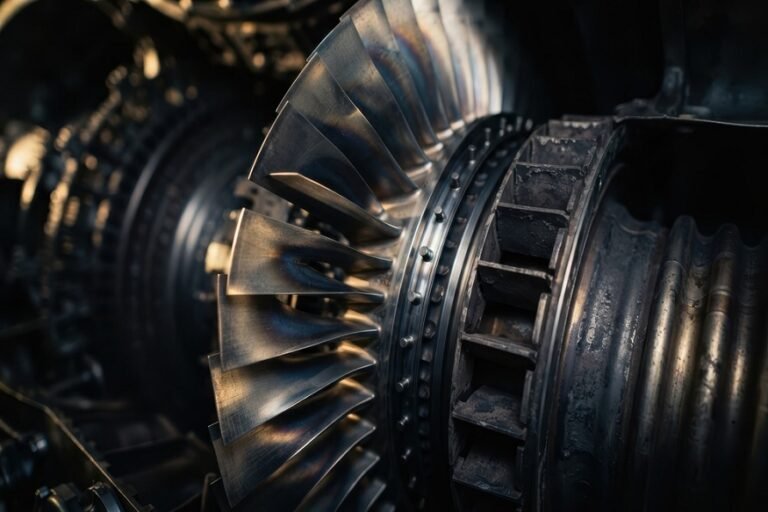
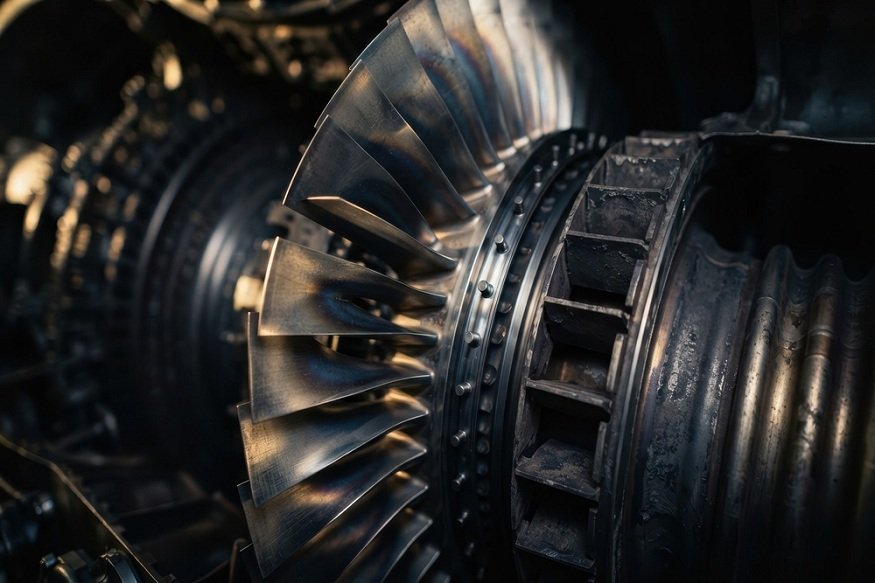
Macro closeup of polished turbine blades, combustion chamber vanes, and heat stained metal inside a jet engine cutaway.
An ordinary carbon fiber bicycle frame and a rocket engine liner made of the same composite material have something in common: both belong to the family of composite materials. However, the similarity ends here. While the former comfortably operates in an ambient environment at a room temperature, the latter must withstand intense heat in a blowtorch without degrading. What separates the two composites?
The Matrix Sets the Limitation
An average composite material uses the low-cost epoxy resin to provide the fibers with structural stability. This is a very strong material but it begins to degrade above 250-350 Fahrenheit depending on its type. Once the temperature is exceeded, the composite material ceases to work as the matrix loosens the fibers even though they are fine. Using bismaleimide or polyimide increases the limit by a few hundred degrees while ceramic matrix composites can operate beyond 2,000 Fahrenheit making them suitable for turbine hot sections and hypersonic leading edges.
Fiber Material Is Key to Part’s Durability
Standard carbon fiber is heat-resistant material. However, it willingly oxidizes and burns in hot air and therefore it is not applicable for parts exposed to high temperatures in an engine. The situation is addressed by silicon carbide fibers which can withstand the effects of high temperature without problems. This is why they are used in the construction of the parts exposed to hot gases for thousands of hours.
There are specialized fibers designed for various unusual applications. For instance, quartz and specialty glass fibers are transparent to radar signals and thus used in radomes and antenna covers. Aramid fibers have high resistance to impact loads which is why they are used in ballistic panels. The choice of fiber depends on the operating conditions, not just on mechanical requirements.
Thermal Shock Must Be Taken Into Account
The operating conditions of extreme environment do not involve constant temperature level. Thus, a reentry vehicle experiences quick change in temperature from very low levels of orbit to very high when entering atmosphere within minutes. The parts of engines experience the same effect as each flight involves numerous cycles of changing temperature from ambient to scorching and vice versa.
When materials inside the composite part expand at various rates, stress appears at boundaries which leads to cracking of the part. While such conditions rarely appear in an average part, extreme environment materials are specially engineered to avoid expansion differences between fiber and matrix. Sounds simple but is definitely not.
Testing Is the Main Challenge
While an average composite only requires passing of the strength tests and some quality checks, the material used in an engine or any other part of a spacecraft must provide thousands of hours of data concerning heat aging, moisture resistance, oxidation, chemical influence, fatigue, and behavior after damage. Each batch must be fully documented and traced.
That is why the experience plays an important role in the supply chain. Axiom Materials is known among ceramic matrix composites manufacturers as a developer of the innovative advanced prepreg and ceramic systems used in qualification programs to produce aerospace and space hardware.
Price Speaks for Itself
A roll of standard carbon prepreg is rather expensive. However, a roll of qualified silicon carbide ceramic prepreg is dramatically more expensive, sometimes by a factor of ten or twenty. Processing of the latter involves additional expenses as ceramic systems typically require multiple infiltration cycles and processing in a furnace during several days. Nobody spends extra money just for fun. People do it because they cannot afford to lose a part in aerospace.
Conclusion
An average composite solves the weight issue. An extreme environment composite solves the survivability problem. Same basic principle but vastly different stakes.
About the Author